
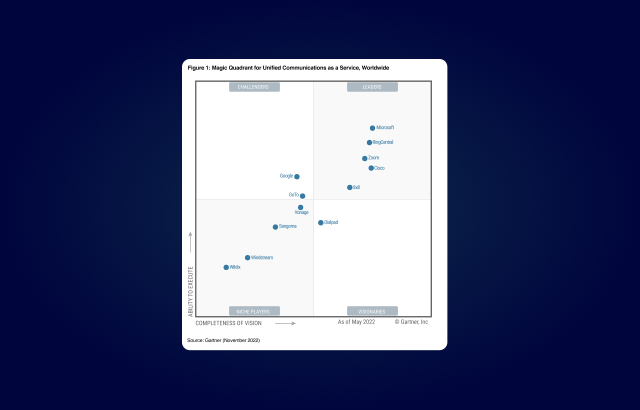
Gartner UCaaS Magic Quadrant 2021: what it means for businesses
The Gartner Magic Quadrant for Unified Communications as a Service (UCaaS) 2021 offered a snapshot of a fast-changing communications market. As organisations adapted to remote and hybrid working, cloud-based phone systems, video meetings and messaging became essential tools for keeping teams and customers connected.
Gartner’s report assessed UCaaS providers on their ability to execute and the completeness of their vision. Its findings can help businesses understand the market, but the quadrant is best used as a starting point—not as a substitute for comparing providers against your own requirements.
What is UCaaS?
Unified Communications as a Service, or UCaaS, brings multiple communication tools together through a cloud-delivered service. Depending on the provider and plan, this can include business telephony, video conferencing, instant messaging, presence information and collaboration features.
Because the service is hosted in the cloud, businesses can typically access it across different locations and devices without managing all the underlying infrastructure themselves. The exact features, integrations and support available vary between providers.
What is the Gartner Magic Quadrant?
The Gartner Magic Quadrant is a graphical assessment of providers in a particular technology market. It places vendors in one of four groups:
- Leaders are assessed as having a strong ability to execute and a well-developed vision for the market.
- Challengers demonstrate strong execution, but may have a less complete vision or a narrower market approach.
- Visionaries present a compelling vision, although their ability to execute may be less established.
- Niche Players may focus on particular regions, customer types or capabilities, rather than competing across the whole market.
These labels describe Gartner’s assessment within the scope of that report. They are not a universal ranking of product quality, and a provider’s position does not necessarily reflect how well it will suit an individual organisation.
Leaders in the 2021 UCaaS Magic Quadrant
In the 2021 report, RingCentral, Microsoft, Zoom and 8×8 appeared in the Leaders quadrant. Their inclusion reflected Gartner’s assessment of their market vision and ability to deliver in the UCaaS sector at that time.
The providers took different approaches to unified communications. Some offered broad platforms bringing together calling, meetings and messaging; others were particularly associated with specific collaboration experiences or business telephony capabilities. Features, pricing, integrations and service arrangements differed, so a place in the same quadrant did not mean the products were interchangeable.
Why the report mattered in 2021
The shift towards remote and hybrid working increased interest in cloud communications. Organisations were looking for ways to support distributed teams, maintain customer contact and bring previously separate communication tools into a more manageable environment.
The 2021 Magic Quadrant provided a view of how Gartner saw the market during that period. It also highlighted a wider industry trend: UCaaS was increasingly about more than moving office phones to the cloud. Buyers were considering how calling, meetings, messaging and business applications could work together.
How to use the Magic Quadrant when choosing a provider
A quadrant position can help create a shortlist, but it should not be the deciding factor. Before choosing a UCaaS service, consider:
- Your communication needs: Identify the calling, meeting, messaging and contact-handling features your teams actually use.
- Integration requirements: Check compatibility with your existing business applications, devices and workflows.
- Call quality and resilience: Understand the provider’s network requirements, service levels and continuity arrangements.
- Security and compliance: Review available controls, data-handling practices and the requirements relevant to your organisation.
- Support and implementation: Ask how migration, staff training and ongoing technical support are handled.
- Total cost: Compare licensing, calling charges, equipment, implementation and support—not just the headline subscription price.
It is also important to check the date of any market assessment. The 2021 report is a historical snapshot, and provider capabilities, ownership, pricing and product strategies may have changed since publication. For a current purchasing decision, use recent information and arrange demonstrations or trials where possible.
Conclusion
The Gartner UCaaS Magic Quadrant 2021 captured an important moment in the growth of cloud communications. RingCentral, Microsoft, Zoom and 8×8 were named Leaders in that edition, but the most suitable provider depends on an organisation’s own priorities, existing systems and budget.
Use the report to understand the market and frame your research, then compare current services against practical business requirements. The right UCaaS platform is the one that helps your people communicate reliably and effectively—not simply the one with the highest profile.
Gartner and Magic Quadrant are registered trademarks and service marks of Gartner, Inc. and/or its affiliates and are used here for identification purposes. Gartner does not endorse any company, vendor, product or service depicted in its research publications and makes no warranties, express or implied, with respect to that research.
Understanding the 2021 Gartner UCaaS Magic Quadrant: Key Insights and Provider Evaluations
- What is the Gartner UCaaS Magic Quadrant 2021?
- Which providers were named Leaders in the 2021 Gartner UCaaS Magic Quadrant?
- How did Gartner assess UCaaS providers in the 2021 Magic Quadrant?
- What is the difference between Leaders, Challengers, Visionaries and Niche Players?
- How should businesses use the 2021 UCaaS Magic Quadrant when choosing a provider?
- Is the Gartner UCaaS Magic Quadrant 2021 still relevant for choosing a communications platform today?
What is the Gartner UCaaS Magic Quadrant 2021?
The Gartner UCaaS Magic Quadrant 2021 was Gartner’s assessment of providers in the Unified Communications as a Service market at that time. It positioned vendors according to their “Ability to Execute” and “Completeness of Vision”, grouping them as Leaders, Challengers, Visionaries or Niche Players. The report offered businesses a way to compare market providers, but its findings were a snapshot from 2021 and should be considered alongside an organisation’s current needs and up-to-date product information.
Which providers were named Leaders in the 2021 Gartner UCaaS Magic Quadrant?
The providers named Leaders in Gartner’s 2021 Magic Quadrant for Unified Communications as a Service (UCaaS) were RingCentral, Microsoft, Zoom and 8×8. Gartner’s assessment reflected its view of their ability to execute and the completeness of their vision at the time; it should be treated as a historical snapshot rather than a guide to their current market positions.
How did Gartner assess UCaaS providers in the 2021 Magic Quadrant?
Gartner assessed UCaaS providers in its 2021 Magic Quadrant across two dimensions: “Ability to Execute” and “Completeness of Vision”. The assessment considered factors such as providers’ products and services, customer experience, sales and operations, alongside their understanding of the market, product strategy, innovation and plans for growth. The resulting positions reflected Gartner’s view of each provider at the time; they were not a guarantee that a particular service would suit every organisation.
What is the difference between Leaders, Challengers, Visionaries and Niche Players?
In Gartner’s UCaaS Magic Quadrant 2021, providers were grouped according to their assessed ability to execute and the completeness of their vision. Leaders scored strongly on both, while Challengers showed solid execution but a less extensive vision. Visionaries had a compelling vision for the market, though their ability to deliver it was assessed as less established. Niche Players tended to focus on particular customers, regions or capabilities rather than competing across the market. These categories reflect Gartner’s assessment at the time; they are not a guarantee that a provider will be the right fit for every business.
How should businesses use the 2021 UCaaS Magic Quadrant when choosing a provider?
Businesses should use the 2021 UCaaS Magic Quadrant as a historical overview of the market and a starting point for creating a shortlist—not as a definitive recommendation. A provider’s position reflects Gartner’s assessment at the time, so businesses should check current offerings and compare them against their own needs, including essential features, integrations, call quality, security, support, reliability and total cost. Trials and demonstrations can help confirm which service is the best fit.
Is the Gartner UCaaS Magic Quadrant 2021 still relevant for choosing a communications platform today?
The Gartner UCaaS Magic Quadrant 2021 is useful for understanding how the market and its leading providers were viewed at the time, but it is now a historical snapshot. Providers’ products, pricing, ownership and capabilities may have changed, so it should not be the sole basis for choosing a communications platform today. Use it as background, then compare up-to-date independent research and assess current services against your organisation’s needs, integrations, security requirements, support expectations and budget.
Tags: 8x8, business communication tools, business telephony, call quality and resilience, choosing a ucaas provider, cloud collaboration, cloud communications, cloud phone systems, gartner ucaas magic quadrant 2021, microsoft, remote and hybrid working, ringcentral, ucaas implementation, ucaas integration, ucaas leaders, ucaas pricing, ucaas provider comparison, ucaas providers, ucaas security and compliance, unified communications as a service, video conferencing, zoom