
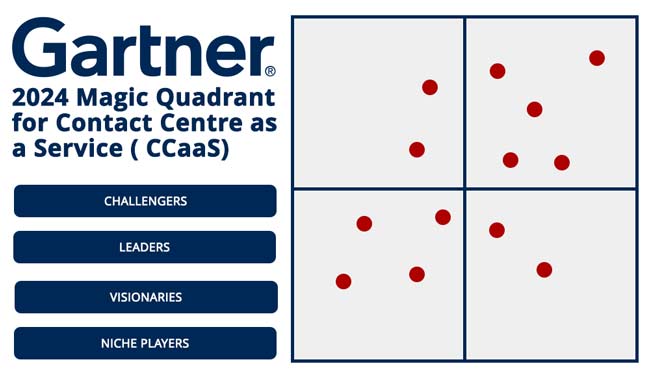
Gartner UCaaS Magic Quadrant 2020: What it showed
The 2020 Gartner Magic Quadrant for Unified Communications as a Service (UCaaS), Worldwide, offered a snapshot of a fast-changing communications market. As organisations adapted to remote and hybrid working during the COVID-19 pandemic, cloud-based calling, video meetings and messaging became increasingly important to day-to-day operations.
The report assessed UCaaS providers on their ability to execute and the completeness of their vision. Its findings can help explain how the market looked at the time, but the Magic Quadrant should be treated as one input into a purchasing decision—not as a definitive ranking of the best services.
What is UCaaS?
Unified Communications as a Service brings communication tools together in a cloud-based service. Depending on the provider and package, this can include business telephony, video conferencing, instant messaging, presence information and collaboration features.
Rather than running all the underlying systems on their own premises, customers typically access the service over the internet and pay on a subscription basis. The provider manages much of the platform, while the customer configures it to suit its users and requirements.
How the Magic Quadrant works
Gartner places evaluated providers in one of four sections according to its assessment of their vision and execution:
- Leaders demonstrate a strong vision and the ability to execute across the market.
- Challengers execute well, but may have a narrower vision or less breadth in some areas.
- Visionaries show a distinctive or forward-looking approach, though their ability to execute at scale may be less established.
- Niche Players may focus on particular regions, customer types or capabilities, rather than serving the whole market broadly.
These positions are Gartner’s assessment of providers against the report’s criteria. They do not mean that every organisation will have the same experience, or that a provider’s position guarantees a good fit for a particular business.
The 2020 market picture
The 2020 report reflected a market in which established telecommunications and enterprise technology suppliers were competing with cloud-first communications companies. Providers were investing in combinations of voice, video, messaging and collaboration, while customers were seeking services that could support distributed teams.
Large vendors such as Cisco, RingCentral, 8×8 and Microsoft featured prominently in discussion of the UCaaS market at the time. Their broad portfolios and established customer bases helped make them important options for organisations comparing cloud communications platforms. The report also assessed other providers, including companies with different regional strengths and product approaches.
Gartner’s placement of a provider should not be confused with a simple score for call quality, customer support or value for money. A company may be well positioned overall and still lack a feature, integration or regional capability that a particular buyer needs. For an exact view of the report’s evaluated vendors and their positions, consult Gartner’s original 2020 research.
Why the report mattered in 2020
The pandemic accelerated the shift towards remote working and made reliable, accessible communications a priority for many organisations. UCaaS could help employees use business communication tools from different locations, while giving IT teams a centrally managed service.
However, moving communications to the cloud also raised practical questions. Buyers needed to consider internet connectivity, emergency calling, number porting, security, regulatory requirements and how the new service would integrate with existing business systems. The 2020 report provided market context, but it could not answer those organisation-specific questions on its own.
How to use the 2020 Magic Quadrant when choosing a provider
Because the report describes the market in 2020, it is a historical reference rather than a guide to today’s product capabilities or vendor performance. Services, ownership, pricing and market positions can change considerably over time.
For a current selection process, businesses should combine recent independent research with practical evaluation. Useful steps include:
- Identify essential requirements, such as telephony, video meetings, messaging and contact-centre integration.
- Check availability, support arrangements and compliance requirements in every country where the service will be used.
- Test call quality and usability with representative users and network conditions.
- Review security controls, resilience, data handling and business continuity arrangements.
- Compare the full cost, including licences, implementation, support, handsets and any required network upgrades.
- Speak to reference customers with needs similar to your own.
Conclusion
The Gartner UCaaS Magic Quadrant 2020 captured a pivotal moment in the development of cloud communications. It helped buyers understand the competitive landscape as organisations rapidly adapted to remote work. Its greatest value today is as a record of how the market was assessed at that time. Any present-day decision should also take account of current services, independent evidence and the specific needs of the organisation.
Five Essential Tips for Navigating the 2020 Gartner UCaaS Magic Quadrant
- Use the 2020 Magic Quadrant as a snapshot, not a current ranking.
- Check Gartner’s criteria for Ability to Execute and Completeness of Vision.
- Match providers’ strengths to your organisation’s needs and priorities.
- Validate claims with demos, references and independent customer feedback.
- Compare total costs, integrations, security and support before choosing.
Use the 2020 Magic Quadrant as a snapshot, not a current ranking.
Use the 2020 Gartner UCaaS Magic Quadrant as a snapshot of the market at that time, not as a current ranking of providers. Since its publication, products, ownership, pricing and vendor capabilities may have changed significantly. If you’re choosing a UCaaS service today, check up-to-date research and assess providers against your own needs, including features, support, security, integrations and total cost.
Check Gartner’s criteria for Ability to Execute and Completeness of Vision.
When reviewing the 2020 Gartner UCaaS Magic Quadrant, look beyond a provider’s position and check Gartner’s criteria for “Ability to Execute” and “Completeness of Vision”. The first considers how effectively a provider delivers its services and supports customers; the second assesses its understanding of the market, strategy and plans for future development. Knowing what sits behind each assessment helps you interpret the chart in context and decide whether the factors Gartner prioritised align with your organisation’s needs.
Match providers’ strengths to your organisation’s needs and priorities.
When using the Gartner UCaaS Magic Quadrant 2020, focus on how each provider’s strengths match your organisation’s needs and priorities, rather than choosing solely by quadrant position. Consider what matters most to your business—such as call quality, collaboration features, integrations, security, support or international coverage—and assess providers against those requirements. The right choice is the one that fits your people, technology and budget; a high position in the 2020 report is useful context, but it does not guarantee the best fit today.
Validate claims with demos, references and independent customer feedback.
When reviewing providers featured in the Gartner UCaaS Magic Quadrant 2020, validate their claims through hands-on demonstrations, conversations with customer references and independent customer feedback. A demo can show how the service works in practice, while references may reveal what implementation and ongoing support are really like. Look for feedback from organisations with needs similar to yours, and compare several sources rather than relying on vendor claims or a single review. This helps you judge whether a provider’s capabilities match your requirements today.
Compare total costs, integrations, security and support before choosing.
Before choosing a UCaaS provider, look beyond its position in the 2020 Gartner Magic Quadrant and compare the factors that matter to your organisation. Assess the total cost, including licences, setup, equipment and ongoing support, and check that the service integrates with your existing systems. Review security and compliance measures, as well as the availability and quality of customer support, to ensure the solution is a good fit for your needs.
Tags: 8x8, ability to execute, business communications, business telephony, call quality, challengers, cisco, cloud communications, cloud-based calling, collaboration tools, communications platform, completeness of vision, compliance, covid-19 pandemic, distributed teams, gartner evaluation criteria, gartner ucaas magic quadrant 2020, hybrid working, instant messaging, leaders, microsoft, niche players, provider selection, remote working, ringcentral, security, ucaas market, ucaas providers, unified communications as a service, vendor performance, video conferencing, visionaries