
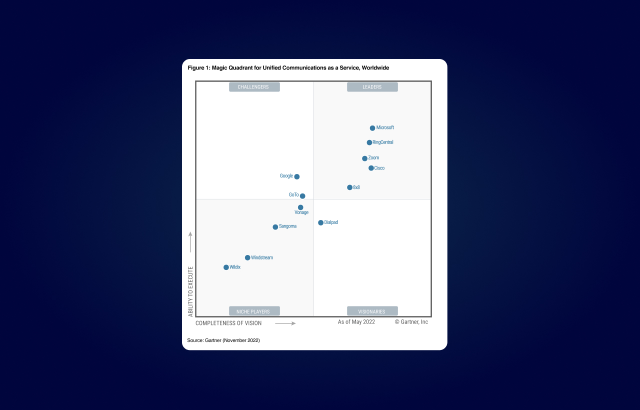
Gartner UC Magic Quadrant 2022: A Guide to the UCaaS Market
The Gartner Magic Quadrant for Unified Communications as a Service (UCaaS), Worldwide, 2022 offered a snapshot of a fast-changing business communications market. It assessed providers of cloud-based services that bring together tools such as business telephony, video meetings, messaging and collaboration.
For organisations reviewing their communications systems, the report can be a useful starting point. It helps explain how providers compare, what capabilities are becoming important and which questions to ask when choosing a service. However, a Magic Quadrant is not a substitute for assessing a provider against an organisation’s own needs.
What is UCaaS?
Unified Communications as a Service is a cloud-delivered model for business communications. Rather than managing separate systems for calls, meetings and messaging, an organisation can access these capabilities through a hosted service. Employees can typically use the service on desk phones, computers and mobile devices.
UCaaS can reduce the need to maintain on-premises communications infrastructure and make it easier to support remote and hybrid working. The precise features vary by provider and plan, so buyers should check what is included, how services integrate with existing systems and what support is available.
How the Magic Quadrant works
Gartner’s Magic Quadrant places assessed providers on a chart using two broad criteria:
- Ability to Execute: how well a provider delivers its services, supports customers and performs in the market.
- Completeness of Vision: how well a provider understands the market and develops its offering for the future.
Providers are grouped into four categories: Leaders, Challengers, Visionaries and Niche Players. These labels describe Gartner’s assessment of providers in the context of the report; they are not a guarantee that a particular service will be the best choice for every organisation.
What the 2022 report was useful for
The 2022 report reflected the growing importance of flexible, cloud-based communications. As organisations continued to support employees working across offices, homes and other locations, they needed services that could deliver a consistent experience across devices and networks.
The report also highlighted the breadth of the market. Providers such as Microsoft, RingCentral, Zoom, Cisco, 8×8, Dialpad, GoTo, Mitel and Vonage offered different approaches to cloud communications. Their products, strengths and commercial models were not identical, making direct evaluation important.
For buyers, the wider lesson was that UCaaS selection involves more than comparing headline features. Reliability, call quality, administration, security, integrations and the quality of customer support can all affect the value of a solution over time.
How to use the Magic Quadrant when choosing a provider
Use the report to create a shortlist and guide further research, rather than treating quadrant placement as a purchasing decision. Before committing, consider:
- Your requirements: Identify the calling, meeting, messaging and contact-centre capabilities your organisation actually needs.
- Integration: Check compatibility with business applications, identity systems, devices and any existing telephony infrastructure.
- Reliability and continuity: Ask about service availability, resilience, incident handling and disaster recovery.
- Security and compliance: Review access controls, data handling, retention options and relevant regulatory requirements.
- Support and migration: Understand how implementation, number porting, training and ongoing support will work.
- Total cost: Compare licensing, devices, calling charges, implementation and support—not just the advertised monthly price.
Why the 2022 findings need context
A Magic Quadrant is a point-in-time assessment. Providers change their products, make acquisitions and update their strategies, while an organisation’s own needs may also shift. The 2022 report should therefore be read as a historical view of the market, not as a current ranking or a replacement for up-to-date product and pricing checks.
It is also important to remember that Gartner’s assessment reflects its defined criteria and research process. A provider outside the Leaders category may still be a strong fit for a particular organisation—for example, if it offers the right integrations, regional support or commercial arrangement.
Conclusion
The Gartner UC Magic Quadrant 2022 helped buyers understand the UCaaS landscape and compare the direction and capabilities of established providers. Its greatest value is as a framework for asking better questions and building a shortlist. The right choice ultimately depends on an organisation’s users, existing technology, service expectations, security requirements and budget.
Key Insights and FAQs on the Gartner UC Magic Quadrant 2022
- What is the Gartner UC Magic Quadrant 2022?
- Which providers were included in the 2022 Gartner Magic Quadrant for UCaaS?
- Which providers were named Leaders in the 2022 UCaaS Magic Quadrant?
- How does Gartner assess providers in the UC Magic Quadrant?
- What is the difference between Leaders, Challengers, Visionaries and Niche Players?
- What trends did the 2022 UCaaS Magic Quadrant highlight?
- How can businesses use the 2022 Magic Quadrant to choose a UCaaS provider?
- Is the Gartner UC Magic Quadrant 2022 still relevant today?
- Where can I find the Gartner Magic Quadrant for UCaaS, Worldwide, 2022?
What is the Gartner UC Magic Quadrant 2022?
The Gartner UC Magic Quadrant 2022 is Gartner’s assessment of providers in the unified communications market, particularly Unified Communications as a Service (UCaaS). It compares vendors using two criteria: their ability to execute and the completeness of their vision, placing them in one of four categories: Leaders, Challengers, Visionaries or Niche Players. The report offers a snapshot of the market in 2022 and can help organisations research providers, but it should not be treated as a current ranking or a substitute for assessing their own requirements.
Which providers were included in the 2022 Gartner Magic Quadrant for UCaaS?
The providers included in Gartner’s 2022 Magic Quadrant for Unified Communications as a Service (UCaaS), Worldwide, were 8×8, Avaya, Cisco, Dialpad, GoTo, Google, Microsoft, Mitel, NEC, RingCentral, Sangoma, Vonage and Zoom. Gartner assessed them against its criteria for ability to execute and completeness of vision; inclusion in the report does not mean every provider will suit every organisation.
Which providers were named Leaders in the 2022 UCaaS Magic Quadrant?
The providers named Leaders in Gartner’s 2022 Magic Quadrant for Unified Communications as a Service (UCaaS), Worldwide, were 8×8, Cisco, Microsoft, RingCentral and Zoom. The designation reflected Gartner’s assessment of their ability to execute and completeness of vision at the time; it does not necessarily mean they were the best fit for every organisation.
How does Gartner assess providers in the UC Magic Quadrant?
Gartner assesses providers in the UC Magic Quadrant against two main criteria: “Ability to Execute” and “Completeness of Vision”. For the 2022 UCaaS report, this involved evaluating factors such as the provider’s products and services, customer experience, market performance, strategy and understanding of future trends. The resulting position reflects Gartner’s assessment of each provider at that time; it is not a guarantee of suitability for every organisation, so buyers should also compare providers against their own requirements.
What is the difference between Leaders, Challengers, Visionaries and Niche Players?
In Gartner’s 2022 UC Magic Quadrant, the four categories describe providers’ positions based on their ability to execute and completeness of vision. Leaders score strongly across both areas, while Challengers demonstrate strong execution but may have a less developed vision. Visionaries show a clear understanding of where the market is heading, but may have less proven execution or reach. Niche Players focus on particular markets, regions or capabilities, or may score lower against the report’s overall criteria. These categories reflect Gartner’s assessment at the time and do not determine which provider is best for every organisation.
What trends did the 2022 UCaaS Magic Quadrant highlight?
The 2022 UCaaS Magic Quadrant reflected the shift towards cloud-based communications that could support hybrid work, bringing voice, video, messaging and collaboration together in a more consistent user experience. It also highlighted providers’ efforts to integrate with business applications, improve administration and security, and extend their platforms through features such as contact-centre services and APIs. These themes showed that buyers were increasingly looking beyond basic cloud telephony towards flexible, connected communications platforms.
How can businesses use the 2022 Magic Quadrant to choose a UCaaS provider?
Businesses can use the 2022 Gartner Magic Quadrant as a starting point for shortlisting UCaaS providers, comparing their ability to execute with the completeness of their vision. However, quadrant placement should not determine the decision on its own: organisations should also assess each provider’s features, reliability, security, integrations, customer support, implementation requirements and total cost against their specific needs. As the report is a snapshot of the market in 2022, businesses should verify current products and services before choosing a provider.
Is the Gartner UC Magic Quadrant 2022 still relevant today?
The Gartner UC Magic Quadrant 2022 can still offer useful historical context on the unified communications market and the criteria Gartner used to assess providers, but it should not be treated as a guide to today’s rankings or product capabilities. Providers, features and pricing change over time, so use the report as a starting point and check current information before making a decision.
Where can I find the Gartner Magic Quadrant for UCaaS, Worldwide, 2022?
You can find the “Magic Quadrant for Unified Communications as a Service, Worldwide, 2022” through Gartner’s website. The full report may require a Gartner subscription or purchase; if you have access through your organisation, try searching the title in Gartner’s research portal. Some assessed providers may also offer authorised copies or summaries, but check that the material is complete and published with Gartner’s permission.
Tags: ability to execute, business communications, call quality, challengers, cloud communications, communications systems, completeness of vision, customer support, gartner uc magic quadrant 2022, integrations, leaders, migration, niche players, provider evaluation, reliability, remote and hybrid work, security and compliance, service provider selection, total cost of ownership, ucaas, unified communications as a service, visionaries