
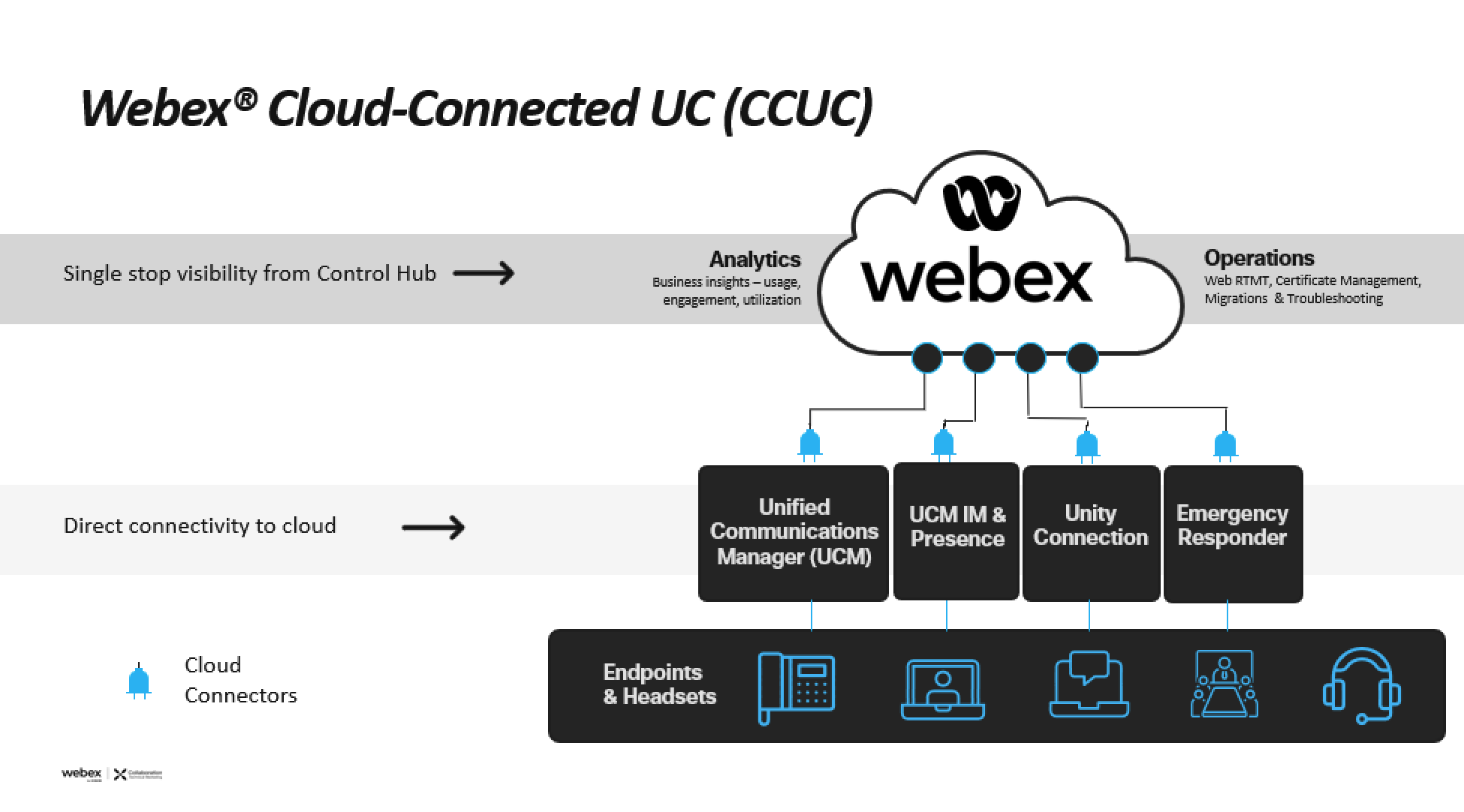
Cisco Cloud CUCM: A Guide to Cloud-Based Cisco Unified Communications
Cisco Cloud CUCM is a common way of describing Cisco Unified Communications Manager (CUCM) hosted in a cloud environment. CUCM is Cisco’s call-control platform for managing voice and video calls, devices and collaboration features across an organisation. Moving it to the cloud can reduce the need to run the platform on equipment at every business site, while retaining many of the capabilities associated with Cisco communications.
The term can refer to different services and deployment models, so it is important to establish exactly what is being offered. A hosted CUCM deployment is not necessarily the same as Cisco’s Webex Calling service, and the features, responsibilities and licensing can vary between solutions.
What is Cisco Unified Communications Manager?
Cisco Unified Communications Manager, often shortened to CUCM or Cisco Unified CM, is an enterprise call-control system. It handles call routing and device registration, and can support features such as voicemail integration, conferencing, directories and call management. Organisations commonly use it with Cisco IP phones and other compatible endpoints.
CUCM has traditionally been deployed on an organisation’s own servers or in a private data centre. With a cloud deployment, the underlying infrastructure and some operational tasks may instead be provided by a cloud platform or managed service provider. The precise division of responsibility depends on the arrangement.
What does “Cisco Cloud CUCM” mean?
There is no single deployment model implied by the phrase “Cisco Cloud CUCM”. It may describe:
- CUCM hosted by a service provider: The provider operates the platform in its data centre and makes it available to customers.
- CUCM running in a public or private cloud: An organisation or partner deploys and manages the software on cloud infrastructure, subject to Cisco’s technical and licensing requirements.
- A hybrid communications environment: Some users, sites or services use cloud-based systems while others continue to rely on on-premises CUCM.
- A move to Webex Calling: An organisation replaces or reduces its CUCM deployment in favour of Cisco’s cloud calling service. This is a different product and migration path, even though it serves a related purpose.
Before choosing a solution, confirm the product name, where the service is hosted, who manages it and which features are included.
Potential benefits of hosting CUCM in the cloud
A cloud-hosted deployment may offer practical advantages, particularly for organisations seeking to modernise their communications without maintaining all of the underlying infrastructure themselves.
- Reduced on-site infrastructure: Less call-control hardware may be needed at individual offices.
- Centralised management: A centrally hosted platform can make it easier to administer users and devices across multiple locations.
- Flexible capacity: Cloud resources may be adjusted as an organisation’s requirements change, depending on the service and contract.
- Access to specialist support: A managed service may include monitoring, maintenance and technical assistance.
- Support for hybrid working: Remote and office-based users can be supported, provided the network, devices and chosen design are suitable.
These benefits are not automatic. Service quality depends on the architecture, provider, internet connectivity, support arrangements and the organisation’s own configuration.
Key considerations before moving CUCM to the cloud
Network and call quality
Voice and video services rely on a dependable network. Before migration, assess internet connectivity, latency, packet loss, bandwidth and network resilience at every relevant site. Quality-of-service settings and backup connectivity may also be important.
Features and integrations
Make a list of the features in use today, including call flows, hunt groups, voicemail, contact centre functions, recording, emergency calling and integrations with business applications. Check that the proposed service supports the required features and that any integrations will continue to work.
Security and compliance
Review how the service protects signalling, media, accounts and call data. Understand where data is hosted, how access is controlled, what security responsibilities remain with the organisation and how the provider handles incidents. UK organisations should also assess relevant data protection, regulatory and internal policy requirements.
Resilience and emergency calling
Clarify how the service behaves during a provider outage or loss of internet connectivity. Confirm the arrangements for emergency calls, including how users’ locations are identified and kept up to date. These details should be tested, not assumed.
Licensing and total cost
Compare the full cost of the proposed service with the current environment. Include subscriptions, implementation, support, network upgrades, devices, carrier services, number porting and any third-party integrations. Licensing can differ between hosted CUCM and cloud calling services, so compare like with like.
Migration planning
A successful migration starts with an audit of the existing CUCM environment. This should cover users, phone models, numbers, call routes, voicemail, integrations, site connectivity and any custom configuration. The organisation can then decide whether to retain CUCM in a hosted model, adopt a hybrid design or move to a different cloud calling service.
Many projects use a phased approach. A pilot with a representative group of users can help uncover issues before wider deployment. A migration plan should also include user communications, staff training, number porting, testing, support arrangements and a clear rollback or contingency process.
Is Cisco Cloud CUCM right for your organisation?
Hosted CUCM may suit organisations that depend on existing Cisco call-control features or integrations and want to change where the platform is operated. A cloud calling service may be a better fit for organisations seeking a more fully managed, cloud-native approach. The right choice depends on technical requirements, existing investments, user needs, compliance obligations and long-term costs.
In short, “Cisco Cloud CUCM” can describe several different solutions. A careful assessment of the exact service, responsibilities, features and migration options will help ensure that the chosen platform meets the organisation’s communications needs.
Cisco Cloud CUCM FAQs: VoIP, PBX, Uses and CUCM vs CME
- What is Cisco cloud?
- Is CUCM a VoIP?
- What is Cisco CUCM used for?
- Is Cisco CUCM a PBX?
- What is the difference between CUCM and CME?
What is Cisco cloud?
Cisco cloud refers to Cisco’s range of cloud-based products and services, which can include networking, security, collaboration and calling solutions. In the context of CUCM, it may mean hosting Cisco Unified Communications Manager on cloud infrastructure or using a Cisco cloud calling service; these are different options, so it is worth checking which service and features a provider means.
Is CUCM a VoIP?
Yes, CUCM supports VoIP, but it is not VoIP itself. Cisco Unified Communications Manager (CUCM) is a call-control platform that manages calls between compatible phones, softphones and other communications devices. It can use Voice over Internet Protocol (VoIP) to carry calls across an IP network, while also supporting other call-routing options depending on the configuration. In short, VoIP is the technology for transmitting voice over IP networks, and CUCM helps control and manage those calls.
What is Cisco CUCM used for?
Cisco Unified Communications Manager (CUCM) is used to manage an organisation’s voice and video communications. It controls call routing and connects compatible phones and other devices, while supporting features such as voicemail, call forwarding, conferencing, directories and call management. In a cloud or hosted deployment, CUCM’s call-control platform runs on cloud infrastructure or in a provider’s data centre rather than solely on the organisation’s own servers.
Is Cisco CUCM a PBX?
Yes. Cisco Unified Communications Manager (CUCM) performs the call-control functions of a private branch exchange (PBX), managing calls between users and connections to the public telephone network. Unlike a traditional PBX, CUCM is software-based and can support IP phones, video endpoints and unified communications features. It can be deployed on-premises or hosted, depending on the solution.
What is the difference between CUCM and CME?
CUCM (Cisco Unified Communications Manager) is an enterprise call-control platform designed for larger or more complex organisations, with centralised management and support for extensive features, integrations and multiple sites. CME (Cisco Unified Communications Manager Express) provides basic call processing for smaller businesses, typically running on a Cisco router and supporting a more limited number of users and features. The right choice depends on the size of your organisation, the complexity of your telephony requirements and the level of scalability and management you need.
Tags: call control, call routing, cisco cloud cucm, cisco ip phones, cisco unified communications manager, cloud communications, cloud infrastructure, cloud migration, cloud-hosted cucm, communications platform, conferencing, cucm, emergency calling, hosted cucm, hybrid communications, licensing, managed services, migration planning, network quality, security and compliance, voicemail integration, webex calling