
Gartner and Unified Communications: What Businesses Need to Know
Unified communications (UC) brings business communication tools together in one connected environment. Depending on the provider and service, this can include voice and video calling, messaging, online meetings, presence information and collaboration features. Gartner is one of the research and advisory organisations businesses may consult when exploring this market.
Understanding what Gartner’s research can—and cannot—tell you is useful when comparing unified communications solutions. A research report can help you understand the wider market, but the right choice will depend on your organisation’s requirements, existing technology and budget.
What is unified communications?
Unified communications aims to make it easier for people to communicate across different channels and devices. Rather than managing separate tools for telephone calls, video meetings and messaging, users may be able to access several services through a shared platform.
Many organisations now consider cloud-based unified communications, often called UC as a Service (UCaaS). With UCaaS, a provider hosts and manages the platform, which users access over the internet. This can reduce the need to maintain on-site communications infrastructure, although service design, connectivity and support arrangements still need careful consideration.
What does Gartner do in the unified communications market?
Gartner publishes research to help organisations assess technology markets and make informed purchasing decisions. Its coverage may include market analysis, provider comparisons and guidance on technology trends. In the unified communications space, Gartner research can help buyers explore areas such as UCaaS, collaboration services and enterprise communication platforms.
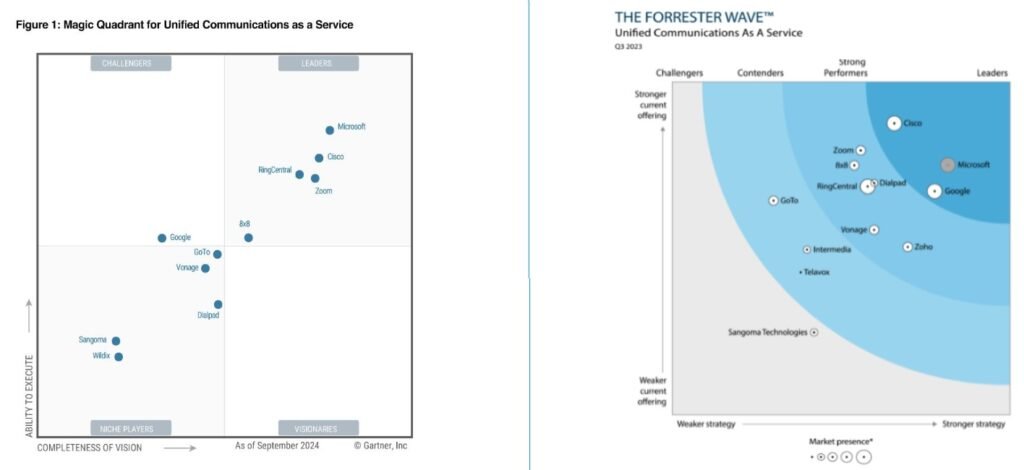
Gartner’s Magic Quadrant is one of its best-known research formats. It places selected providers into categories based on Gartner’s assessment of their ability to execute and the completeness of their vision. The graphic offers a way to compare vendors within the scope of a particular report.
However, a Magic Quadrant is not a complete list of every provider, nor is it a recommendation tailored to every buyer. The providers included, evaluation criteria and market definition are specific to each report. Businesses should read the accompanying analysis, not rely on the graphic alone.
How to use Gartner research when choosing a UC solution
Gartner research can be a helpful starting point, but it works best alongside your own requirements and evaluation process. Before comparing providers, consider the following:
- Calling requirements: Identify the locations, call volumes, number ranges and features your organisation needs.
- Collaboration tools: Decide whether you need video meetings, team messaging, file sharing or integrations with other workplace applications.
- Existing systems: Check how a proposed service will work with your current telephony, contact centre, network and business software.
- Reliability and resilience: Ask about service availability, backup arrangements, disaster recovery and what happens during an internet or power outage.
- Security and compliance: Review the provider’s security controls, data handling, administrative features and support for your regulatory obligations.
- Support and implementation: Understand how migration, user training, ongoing support and service changes will be handled.
- Total cost: Compare the full cost of the service, including licences, calls, devices, connectivity, implementation and support.
Why a provider’s position is only part of the decision
A provider’s inclusion or position in a Gartner report may offer useful context, but it does not automatically mean that its service is the best fit for your organisation. A large international business and a small UK firm may have very different needs. One may prioritise global coverage and advanced integrations; another may value straightforward administration, responsive support and predictable costs.
It is also important to compare the specific services being proposed. Providers can offer different packages, features and support models, even within the same product family. Ask for a demonstration, check the details of the contract and speak with the provider about your own call flows and working practices.
Questions to ask UC providers
When shortlisting unified communications providers, consider asking:
- Which features are included in the quoted package?
- Can the service support our users across different offices and remote locations?
- What internet connection and local network setup will we need?
- How will our existing numbers and equipment be handled during migration?
- What support is available, and when?
- How are service performance and outages communicated?
- What are the contract terms, renewal conditions and exit arrangements?
Making an informed choice
Gartner’s research can help businesses understand the unified communications landscape and identify questions to explore. It should be treated as one source of information rather than a substitute for a detailed assessment of your requirements.
By defining what your organisation needs, comparing complete service proposals and checking how each option will work in practice, you can make a more confident decision. The most suitable unified communications solution is the one that supports your people, customers and working practices—not simply the one that appears highest in a chart.
Understanding Gartner’s Insights on the Unified Communications Market: Key Questions Answered
- What is Gartner’s view of the unified communications market?
- What is Gartner’s Magic Quadrant for unified communications?
- Which unified communications providers does Gartner evaluate?
- How does Gartner assess unified communications providers?
- How can businesses use Gartner research to compare UCaaS providers?
- Does Gartner recommend the best unified communications provider for every business?
What is Gartner’s view of the unified communications market?
Gartner views the unified communications market through its research into services such as UCaaS, business telephony, messaging and online collaboration. Its reports assess market trends and compare selected providers against defined criteria, helping organisations understand the options available. Because the market and Gartner’s research change over time, a report should be treated as a snapshot rather than a definitive ranking or a recommendation for every business; the right solution depends on an organisation’s needs, existing systems and budget.
What is Gartner’s Magic Quadrant for unified communications?
Gartner’s Magic Quadrant for unified communications is a research report that assesses selected providers in a defined market, based on Gartner’s evaluation of their ability to execute and completeness of vision. It groups providers into categories to help organisations compare their market positions, but it is not a ranking or a personalised recommendation. Read the report’s analysis and methodology alongside your own requirements, and check that its scope and publication date are relevant to your decision.
Which unified communications providers does Gartner evaluate?
The unified communications providers Gartner evaluates can vary between reports, as each assessment has its own scope, criteria and publication date. Gartner may include providers that meet the report’s eligibility requirements, so its research should not be treated as a complete list of every provider in the market. For the most accurate information, check the latest Gartner report and its evaluation criteria.
How does Gartner assess unified communications providers?
Gartner assesses unified communications providers using criteria set out in each relevant research report, which may include a provider’s ability to execute and the completeness of its vision. Its analysis can consider factors such as product capabilities, strategy, market presence and customer experience, but the criteria and scope vary by report. Gartner’s assessments are intended to support market research—not to provide a personalised recommendation—so businesses should review the report’s methodology and compare providers against their own needs.
How can businesses use Gartner research to compare UCaaS providers?
Businesses can use Gartner research as a starting point for comparing UCaaS providers, reviewing its market analysis and the criteria used to assess vendors. Reports such as the Magic Quadrant can help explain how selected providers differ, but they are not a tailored recommendation or a complete list of options. Businesses should check the report’s scope and date, then compare shortlisted services against their own needs—including features, integrations, reliability, security, support and total cost—before making a decision.
Does Gartner recommend the best unified communications provider for every business?
No. Gartner’s research can help businesses compare providers and understand the unified communications market, but it does not identify one provider as the best choice for every organisation. The right solution depends on factors such as your size, budget, existing systems, security needs and the way your teams work. Use Gartner’s analysis as a starting point, then assess providers against your own requirements.
Tags: business communications, cloud communications, collaboration tools, communication providers, communications solutions, enterprise communications, gartner, gartner magic quadrant, gartner unified communications, implementation and support, provider comparison, security and compliance, service reliability, team messaging, technology research, total cost of ownership, uc, ucaas, unified communications, vendor evaluation, video meetings